-ai.svg)


## Why the Early Years Matter for Language Development
Your toddler just said their first full sentence. Your preschooler won't stop asking "why?" about everything. Your infant is babbling away, testing out sounds that will soon become words.
These everyday moments? They're not just adorable. They're critical windows for language development that shape how your child will communicate for the rest of their life.
Here's what the research tells us: children learn language most rapidly between birth and age five. During these years, their brains form over one million neural connections every second. The conversations they hear, the stories they listen to, the words they practice—all of it lays the foundation for reading, writing, and social skills they'll use throughout school and beyond.
But here's what catches many parents off guard: not all early childhood programs support language development equally. Licensed daycares with trained educators and intentional curriculum create language-rich environments that go far beyond simple childcare. Let's look at how quality early education programs nurture your child's communication skills during these precious early years.
## What Makes a Language-Rich Environment?
A language-rich environment isn't about talking at children. It's about creating meaningful conversations with them throughout the day.
In quality licensed daycares, every routine and activity becomes an opportunity for language learning.
Licensed educators understand that language development happens through:
-
Back-and-forth conversations: Teachers who respond to infant coos, toddler gestures, and preschooler questions with genuine interest and expanded language
-
Narration of daily activities: Describing what's happening during diaper changes, mealtimes, and transitions helps children connect words with actions and objects
-
Rich vocabulary exposure: Introducing new words beyond basic labels—not just "dog" but "puppy," "bark," "furry," and "playful"
-
Responsive interactions: Following children's lead and building on their interests, rather than directing all conversations
-
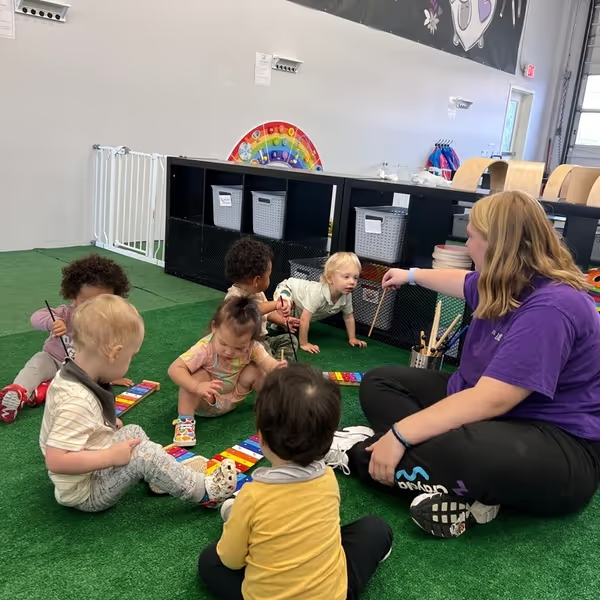
Singing and Music: Singing helps with memory retention, repetition, and articulation of new words, longer phrases, and expressions
At Harwell School, our licensed educators create these language-rich moments throughout our play-based curriculum. Whether children are exploring our dedicated STEM spaces, creating in our arts area, or making music together, teachers weave vocabulary, questions, and conversations into every experience.
## Age-Appropriate Language Support: Infants Through Pre-K
Language development looks different at every stage. Licensed educators trained in early childhood development know exactly how to support each age group.
### Infants (3-14 Months)
For our youngest learners, language development starts with listening and responding. Licensed educators:
- Respond consistently to cries, coos, and babbles, teaching infants that communication gets results
- Use parentese (that sing-song voice) which research shows helps babies distinguish speech sounds
- Name objects, people, and actions throughout routines
- Read board books with simple, repetitive text
- Sing songs and recite nursery rhymes that expose babies to rhythm and rhyme
### Wobblers and Toddlers (14-35 Months)
This is when language explodes. Toddlers might learn 10 new words per day. Quality programs support this by:
- Expanding on toddlers' one or two-word phrases ("Dog!" becomes "Yes, that's a big brown dog running!")
- Asking open-ended questions during play
- Providing choices that encourage verbal responses
- Reading interactive books that invite participation
- Creating dramatic play opportunities where children practice conversational skills
### Preschool and Pre-K (3-5 Years)
Older preschoolers are ready for more complex language experiences. Licensed educators:
- Introduce new vocabulary through thematic units and projects
- Encourage storytelling and narrative skills
- Support early literacy through phonological awareness activities
- Model complex sentence structures and grammar
- Create opportunities for peer conversations and collaborative problem-solving
Our curriculum at Harwell supports each developmental stage with age-appropriate activities in dedicated learning spaces. From our infant rooms where teachers narrate every diaper change to our Pre-K classrooms where children engage in rich discussions during STEM experiments, language learning is woven into every moment.
## The Role of Play in Language Learning
Here's something that surprises many parents: play isn't just fun—it's the most powerful context for language development in early childhood.
When children engage in pretend play, build with blocks, or explore sensory materials, they're naturally motivated to communicate. They negotiate roles ("I'll be the doctor!"), solve problems ("We need more blocks for the roof"), and create narratives ("The baby is crying because she's hungry").
A play-based curriculum creates countless opportunities for:
- Vocabulary growth: Children learn words like "balance," "underneath," "measure," and "pattern" through hands-on experiences
2. Conversational skills: Taking turns, listening, and responding during collaborative play
-
Narrative development: Creating stories during dramatic play strengthens the same skills needed for reading comprehension
-
Question-asking: Exploring materials naturally prompts children to wonder and ask "why?" and "how?"
Licensed educators in quality programs know how to extend play with intentional language support. They join children's play as conversation partners, introduce new vocabulary in context, and ask thoughtful questions that encourage deeper thinking and more complex language use.
## How Parent Communication Supports Language Development
One often-overlooked advantage of licensed daycares? Their structured communication with families.
When parents know what their child is learning and experiencing each day, they can reinforce that language learning at home.
Quality programs provide:
- Daily updates about activities, conversations, and milestones
- Regular developmental check-ins that include language progress
- Specific examples of new words or phrases children are using
- Suggestions for extending learning at home
At Harwell School, we provide daily app updates so parents stay connected to their child's day. We also offer monthly milestone check-ins and three annual assessments with parent conferences. These touchpoints help parents understand their child's language development and partner with teachers to support continued growth.
When there's consistency between home and school—using similar vocabulary, reading the same books, singing the same songs—children's language skills flourish. This partnership between licensed educators and families creates the richest possible language environment for young learners.
## What to Look for in a Language-Rich Program
Not all licensed daycares are created equal when it comes to language development. As you tour programs, look for these signs:
## In the classroom
- Teachers engaged in conversations with children, not just managing behavior
- Children's voices and ideas valued and extended
- Books displayed and accessible throughout the room
- Labels and print visible in the environment
- Background noise kept low so children can hear clearly
## In the curriculum
- Intentional activities that build vocabulary and concepts
- Daily read-aloud times with engaging, age-appropriate books
- Music and movement activities that support phonological awareness
- Opportunities for both adult-child and peer conversations
- Documentation showing how teachers track language development
## In teacher qualifications
- Licensed educators trained in early childhood development
- Staff who understand language milestones for each age group
- Professional development focused on communication and literacy
When you schedule a tour at Harwell School, you'll see our licensed educators in action, creating these language-rich experiences across our infant through Pre-K programs. You'll observe how our dedicated spaces for STEM, arts, and music provide varied contexts for vocabulary growth and meaningful conversations.
## Supporting Your Child's Unique Language Journey
Every child develops language at their own pace. Some toddlers are early talkers. Others are careful observers who wait until they're ready.
Quality licensed daycares recognize and support this individual variation.
Licensed educators are trained to:
- Recognize typical language milestones and variations
- Identify when additional support might be beneficial
- Adapt their communication style to each child's needs
- Partner with families and specialists when concerns arise
- Celebrate each child's progress, whatever their starting point
This individualized attention is one of the greatest advantages of licensed early childhood programs. With regular developmental check-ins and trained observation skills, educators can make sure every child receives the language support they need to thrive.
Whether your child is in our infant program just beginning to babble, or in our Pre-K classroom telling elaborate stories, our educators meet them where they are and support their next steps in language development.
## Investing in Your Child's Communication Future
The language skills your child develops in their first five years will serve them for a lifetime. Strong early language skills predict:
- Reading success in elementary school
- Academic achievement across subjects
- Social-emotional competence and friendship skills
- Confidence in expressing ideas and needs
- Career opportunities in adulthood
Choosing a licensed daycare with trained educators and an intentional curriculum isn't just about childcare—it's an investment in your child's communication abilities and future success.
At Harwell School, we understand the profound importance of these early years. Our play-based curriculum, dedicated learning spaces, and licensed educators create language-rich environments where infants through pre-kindergarteners develop strong communication skills naturally, through joyful daily experiences.
Ready to see how we support language development at every age and stage? Schedule a tour at our Beaverton location (14480 SW Jenkins Rd, open 6:45 AM to 5:45 PM Monday through Friday) or our Oregon City location (14292 Marjorie Ln, open 7:00 AM to 5:30 PM Monday through Friday). Come observe our educators in action, explore our dedicated learning spaces, and discover how we can support your child's language journey from infants through Pre-K. We also offer FlexED options for families seeking part-time programs.
Your child's words matter. Let's nurture them together.
.webp)