-ai.svg)


Why Early Childhood Education Matters: The Science Behind Lifelong Learning
You watch your toddler stack blocks with intense concentration, or your preschooler ask "why?" for the hundredth time today, and you wonder: Is this just play, or is something deeper happening?
Here's the thing: those seemingly simple moments—the block tower that crashes down, the endless questions, the messy finger painting—aren't just keeping your child busy. They're literally building the architecture of your child's brain. Creating neural pathways that will shape how they learn, think, and connect with others for the rest of their lives.
As parents in the Portland metro area increasingly recognize the value of quality early childhood education, understanding why these early years matter so profoundly can help you make informed decisions about your child's care and learning environment.
The Brain Science You Need to Know
The research is clear: a child's brain develops more rapidly between birth and age five than at any other time in life. During these years, more than one million neural connections form every second—a pace that will never be repeated.
But here's what catches many parents by surprise: these connections don't form automatically. They develop in response to experiences, interactions, and environments. Every conversation, every solved problem, every social interaction is quite literally shaping your child's brain structure.
Neuroscientists have discovered that early experiences don't just create isolated skills—they build the foundational architecture that all future learning rests upon. Think of it like constructing a building. The quality of the foundation determines what's possible in everything built on top of it.
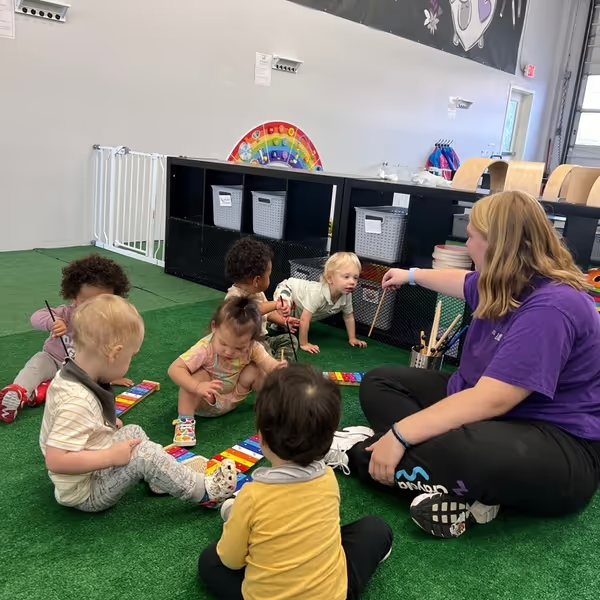
This is why the type of early childhood education your child receives matters so much. A play-based curriculum that encourages exploration, problem-solving, and social interaction isn't just fun—it's developmentally essential. When children engage with STEM activities in dedicated learning spaces, experiment with arts and music, and navigate social situations with peers, they're not just learning content. They're developing the capacity to learn itself.
Beyond ABCs: What Children Really Learn in Quality Early Education
When many parents think about early childhood education, they picture alphabet charts and counting exercises. But the most valuable learning happening in these years goes far deeper.
Quality early childhood programs focus on developing the whole child across multiple areas:
Cognitive Development
- Executive function skills: The ability to focus attention, hold information in working memory, and exercise self-control
- Problem-solving abilities: Learning to approach challenges systematically and persist through difficulty
- Critical thinking: Asking questions, making observations, and drawing conclusions
These cognitive skills are the engines of all future learning.
.webp)